Classes for CMMI V3 (Capability Maturity Model Integration)
The Process Group is a CMMI Institute certified provider of appraisals and training for V3 classes (Services and Development).
The instructors have been helping companies fully utilize CMMI since 1989.
What is CMMI?
CMMI is a collection of best practices used by software, hardware, IT development, and service organizations to improve their cost, schedule, and quality results. It is organized into a roadmap that can be implemented incrementally over time.
Useful links:
- Changes in CMMI V3
- CMMI Appraisals
- Other useful links: See bottom of this page
Available classes (Virtual delivery or onsite at your location)
- Achieving CMMI-Development Maturity Levels 2 & 3 Efficiently – NEW online recorded class
- Achieving CMMI-Services Maturity Levels 2 & 3 Efficiently – NEW online recorded class
- CMMI V3 overview (1-3 hours)
- Foundations of Capability (2 days) + Building Development Excellence (1 day)
- Foundations of Capability (2 days) + Building Services Excellence (1 day)
- Implementing CMMI Maturity Levels 2 and 3, (DEV or SVC)
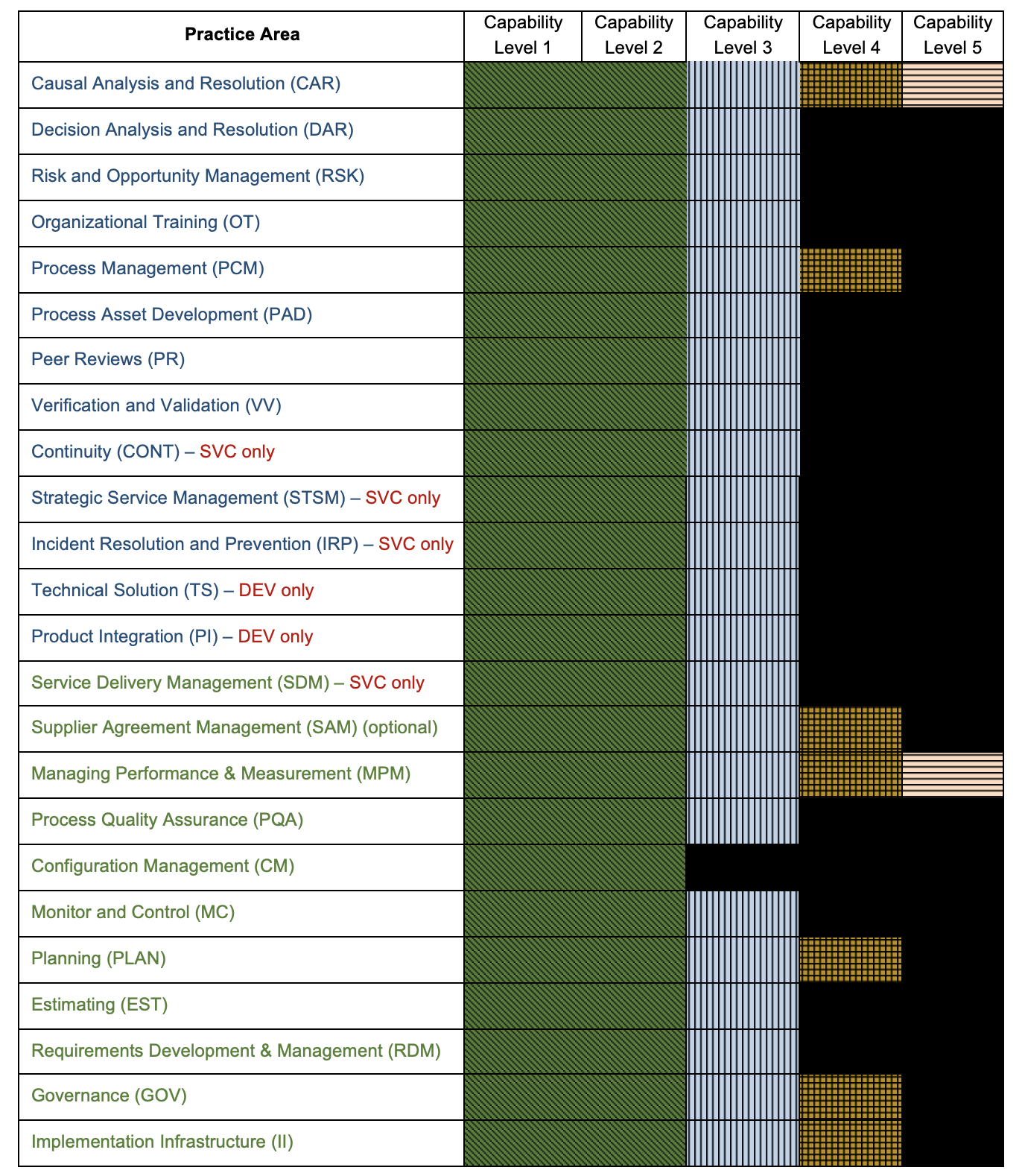 CMMI V3 DEV and SVC Model
(Maturity Level 2 = Green Shaded Area
Maturity Level 3 = Green + Blue Shaded Area
Maturity Level 4 = Green + Blue + Dark Brown Shaded Area
Maturity Level 5 = Green + Blue + Dark + Light Brown Shaded Area)
Many organizations try to improve their quality and productivity by establishing a company-wide process improvement program. These programs often result in large amounts of process documentation which eventually becomes a burden or is ignored completely. In many cases, the organization is left with very little benefit to show for its efforts.
The Capability Maturity Model provides organizations with a set of best practices organized into a roadmap to improve business performance.
Each of our workshops focus on using CMMI practices to achieve business goals and solve real problems. As participants learn about each model component, they select elements that best help them move towards their goals and fix their problems. At the end of the workshop, they group all the actions into a draft action plan.
Throughout the workshops we discuss the problems that people encounter while doing process improvement. These include over-documenting processes, implementing too much change at once, resistance to change, rote use of the CMMI, and maintaining management buy-in.
The instructors (Neil Potter and Mary Sakry) are both CMMI Institute-certified providers of CMMI workshops, and Lead Appraisers for the Benchmark process appraisal method. They have been using and teaching the model since 1989. They are also co-authors of two books, “Making Process Improvement Work,” Addison-Wesley. Mary and Neil are experienced in teaching these workshops to mixed audiences, including IT, software engineering, hardware engineering and service organizations.
Achieving CMMI-Development Maturity Levels 2 & 3 Efficiently (3 hours)
On-Demand Recorded Class
$149/person
 This 3-hour self-paced class explains how to use CMMI for Development to address business goals and problems directly and avoid creating bloated documentation. The class will focus on Maturity Levels 2 and 3 of the Development model. Money-back guarantee if not satisfied.
Workshop Agenda
- Overview of CMMI
- What does it mean to implement CMMI efficiently?
- An approach to make the model always useful and avoid a “compliance” focus
- Using checklists
- Does the lifecycle you are using matter?
- How practices and PAs can be grouped together
- Project management PAs — efficient implementation examples
- Engineering PAs — efficient implementation examples
- Project support PAs — efficient implementation examples
- Improvement PAs — efficient implementation examples
- Class summary
Click here to watch the free preview of the class
Click here to purchase it
Notes:
- The class is purchased and run on the Teachable.com platform in a browser
- VAT is added when purchases are from Europe
- Use any browser except Microsoft edge
- Check the playback speed is 1x (select the gear wheel on video screen to adjust)
Achieving CMMI-Services Maturity Levels 2 & 3 Efficiently (3 hours)
On-Demand Recorded Class
$149/person
 This 2.5-hour self-paced class explains how to use CMMI for Services to address business goals and problems directly and avoid creating bloated documentation. The class will focus on Maturity Levels 2 and 3 of the Services model. Money-back guarantee if not satisfied.
Workshop Agenda
- Overview of CMMI
- What does it mean to implement CMMI efficiently?
- An approach to make the model always useful and avoid a “compliance” focus
- Using checklists
- Does the lifecycle you are using matter?
- How practices and PAs can be grouped together
- Project management PAs — efficient implementation examples
- Services + requirements, peer reviews and Ver/Val PAs — efficient implementation examples
- Project support PAs — efficient implementation examples
- Improvement PAs — efficient implementation examples
- Class summary
Click here to watch the free preview of the class and purchase it
Click here to purchase it
Notes:
- The class is purchased and run on the Teachable.com platform in a browser
- VAT is added when purchases are from Europe
- Use any browser except Microsoft edge
- Check the playback speed is 1x (select the gear wheel on video screen to adjust)
Overview of CMMI-DEV or CMMI-SVC (1-3 hours)
In this session, one of our CMMI Institute-certified instructors will explain the model and how it is used to improve the performance of an engineering or services company.
This presentation can be tailored to meet your specific needs. Contact us to schedule a class.
Workshop Agenda
- Overview
- Who is the CMMI Institute?
- What is CMMI?
- Characteristics of Levels 1, 2, 3, 4 and 5
- Improving your business with CMMI (focusing on results, not paperwork)
- Relation to other frameworks (ISO 9001, Lean, Six Sigma, Agile/Scrum, PMBOK)
- Appraisals
- Performing a gap analysis (options)
- Appraising small and large groups
- Q & A
Audience
- Senior managers looking to improve their organization’s performance and efficiency
- Personnel who are leading process improvement
- Appraisal teams who are going to be using a CMMI-based appraisal method in the future
Learning objectives
- Provide an overview of the model, its benefits, and advice on how to use it to address business goals and challenges
Customized versions can be delivered. Contact us.
CMMI V3 — Foundations of Capability (2 days) + Building Development Excellence (1 day)
The class introduces participants to the CMMI framework and how to use the practices immediately to improve an organization’s schedule, cost, and quality results. Contact us to schedule a class.
Workshop Agenda
- Numerous implementation examples for each Practice Area
- How Practice Areas can be grouped and baked into 1-page processes
- Your organization’s strengths and initial gaps — obtain a score of where you are during the class
- Improvement planning based on the business goals of the group
- Writing essential processes that fit the work of the group
- Developing an improvement plan tied to the business goals/needs of the organization
- Summary 1 hour briefing for management at the beginning (CMMI overview)
- Summary 1 hour briefing for management at the end (next steps)
- Preparation for the CMMI Associate exam (required for appraisal team members)
Audience
- Senior managers looking to improve their organization’s performance and efficiency
- Systems, hardware, and Software Engineering Process Group (SEPG / EPG) members who are leading process improvement
- Future CMMI appraisal team members
Learning Objectives
The course will help participants to:
-
Apply CMMI practices to the project management and engineering challenges you face
-
Learn how to focus CMMI on results and not paperwork
-
Learn to implement CMMI using light-weight checklists that can be used every day by a project team
-
Understand the architecture of the CMMI model (maturity levels, practice areas, capability levels, practices, and views)
- Develop a mapping of CMMI practices to your organization’s goals and problems
-
Qualify as a CMMI appraisal team member
Customized versions can be delivered. Contact us.
CMMI V3 — Foundations of Capability (2 days) + Building Services Excellence (1 day)
The class introduces participants to the CMMI framework and how to use the practices immediately to improve an organization’s schedule, cost, and service quality results. Contact us to schedule a class.
Workshop Agenda
- Numerous implementation examples for each Practice Area
- How Practice Areas can be grouped and baked into 1-page processes
- Your organization’s strengths and initial gaps — obtain a score of where you are during the class
- Improvement planning based on the business goals of the group
- Writing essential processes that fit the work of the group
- Developing an improvement plan tied to the business goals/needs of the organization
- Summary 1 hour briefing for management at the beginning (CMMI overview)
- Summary 1 hour briefing for management at the end (next steps)
- Preparation for the CMMI Associate exam (required for appraisal team members)
Audience
- Senior managers looking to improve their organization’s performance and efficiency
- Service delivery managers and staff who are leading process improvement
- Future CMMI appraisal team members
Learning Objectives
The course will help participants to:
-
Apply CMMI practices to the project management and service challenges they face
-
Learn how to focus CMMI on results and not paperwork
-
Learn to implement CMMI using light-weight checklists that can be used every day by a project team
-
Understand the architecture of the CMMI model (maturity levels, practice areas, capability levels, practices, and views)
- Develop a mapping of CMMI practices to your organization’s goals and problems
-
Qualify as a CMMI appraisal team member
Customized versions can be delivered. Contact us.
Implementing CMMI Maturity Levels 2 and 3, (DEV or SVC)
If you need to implement CMMI Levels 2 or 3 quickly, we can provide everything you need. We have over 30 years of experience in CMMI implementation. Our approach is to use efficient checklists and templates that cover the model practices and tie them to your workflow as a natural part of how you work. Contact us to discuss your needs.
We will assess where you are today, teach you how to make ALL CMMI practices useful to run your business, teach you how to organize and write processes that are one-page in length, and provide skills for the identified gaps.
We can be your Lead Appraiser assuming you do the implementation work, and we remain objective. If you have already selected a Lead Appraiser, we can help you:
- Establish business goals, define challenges to address, and measures needed (step 1 below)
- Perform an in-depth mini appraisal / gap analysis (step 3 below)
- Plan the improvement effort (step 4 below)
- Implement the improvement plan (step 5 below)
Improvement Events
Step 1: Establish business goals, challenges to address, and measures:
- Define your context for CMMI adoption
- Define goals and challenges to address with CMMI practices
- Define measures that you care about to monitor progress
Step 2: Learn about CMMI and perform an informal gap analysis. Options:
- CMMI Foundations + Development/Services workshop (3-4 days)
Step 3: Perform an in-depth mini-appraisal / gap analysis:
- Plan an event for 1-5 days based on scope and thoroughness needed
- Conduct interviews of project managers and team members
- Review example artifacts
Step 4: Plan the improvement effort (1 or 2 days):
- Set priorities
- Define tasks
- Assign responsibilities and define pilot teams
- Develop baseline measures
- Assess risks
- Establish milestones, tracking and communication
Step 5: Implement the improvement plan
- Provide customized skills to run the business while addressing the gaps (e.g., requirements, design, planning, estimation, risk, defect identification, improvement, Decision Analysis and Resolution, test planning and analysis).
Step 6: Conduct the final Benchmark appraisal
- Plan an event for 3-10 days based on the size of the organization and model scope
- Conduct interviews and artifact review
- Provide an official rating
Customized versions can be delivered. Contact us.
Useful links
 The Process Group helps you improve your organization's capability to routinely meet deadlines and delivery quality expectations. We are certified CMMI appraisers / trainers and Certified Scrum Masters.